Jobs to Be Done is the Growth Forge® Software tool for capturing what your customers are really trying to accomplish, independent of any solution. You define each need as a clear job, tagged by who has it, where it sits in the customer journey, and how often it occurs, so your requirements and competitive analysis are grounded in real, structured customer need rather than assumptions.
New-product or business project leaders and startup founders framing a concept's value based on real unmet needs, plus researchers turning interview notes into structured insight.

What is the Jobs to Be Done tool in Growth Forge?
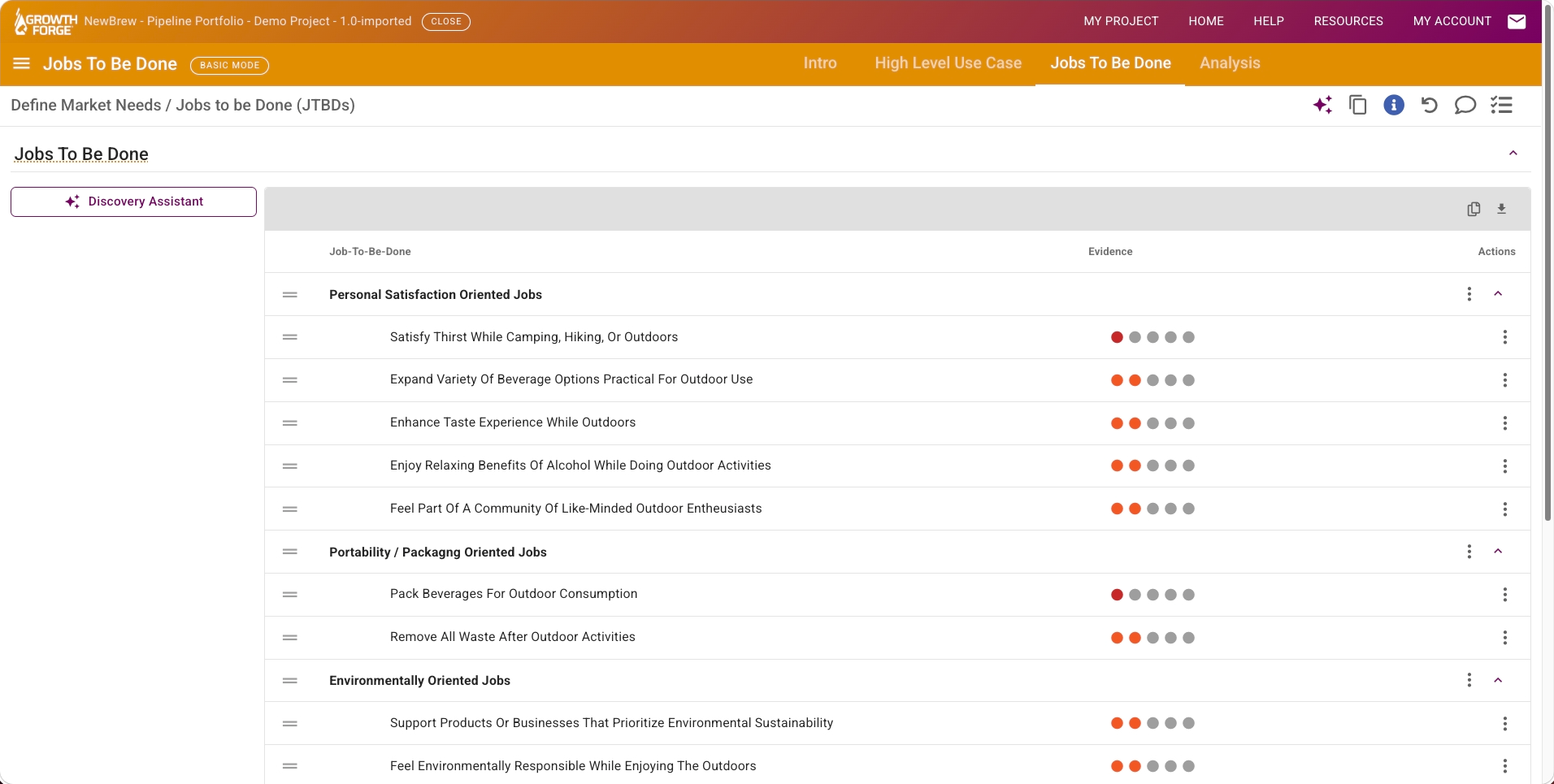
It's the tool for defining what customers are trying to accomplish as structured, solution-agnostic "jobs" across the full customer journey. Each job is captured as verb + object + context and tagged by who has it, where it occurs, and how often, giving your requirements and competitive work a real, evidence-grounded foundation instead of a feature wish-list.
How do I do a jobs-to-be-done analysis for a product or business idea?
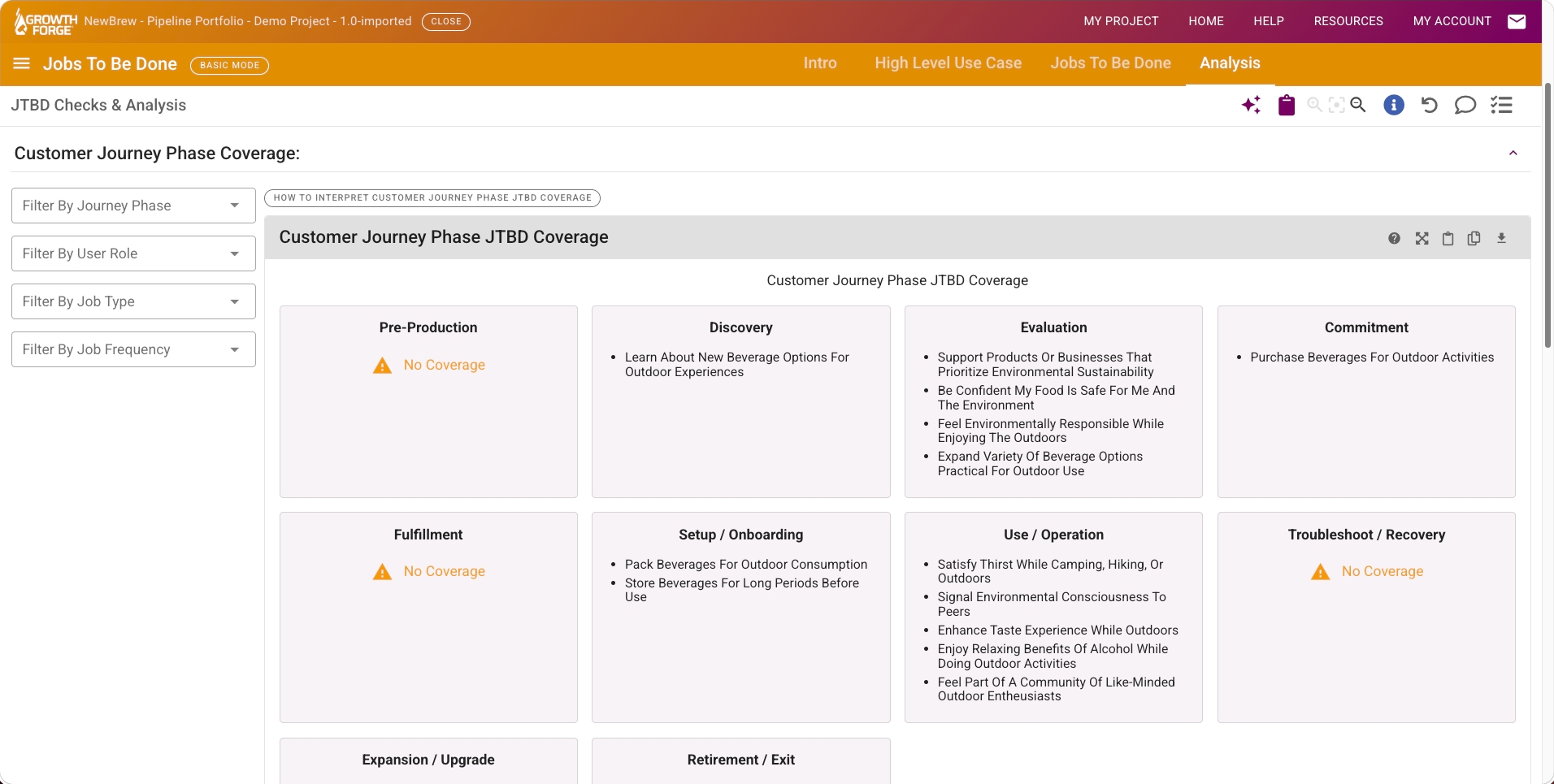
Frame the use case (scenario, end customer, goal, how people cope today), gather evidence through discovery interviews, then capture the jobs, functional, emotional, and social, across every journey phase. Growth Forge structures each job consistently and maps coverage so you can see where you're thin, and AI Discovery Assistants can propose candidate jobs you may have missed.
What's the difference between a job, a need, a feature, and a requirement?
A job is what the customer is trying to get done, independent of any product; a need is that job expressed as an unmet outcome; a feature is a specific solution; and a requirement is a measurable target. Jobs to Be Done stays deliberately on the need side, keeping it solution-agnostic gives you the freedom to consider potentially disruptive solutions beyond established product categories, and then feeds the Requirements tool, which turns jobs into measurable requirements.
What kinds of jobs does it capture?
Functional, emotional, and social jobs, across all nine journey phases from discovery through retirement, and for every key performer (primary user, purchase decision maker, technical approver, admin). That breadth is how it surfaces needs a feature-first process would miss.
Does it use AI, and does it stay grounded?
Yes, AI Discovery Assistants propose candidate jobs, including from your Problem Discovery interviews, and you review and accept what fits. You always control what is kept, so the map stays grounded in your evidence.
What does it connect to?
It draws on Problem Discovery interviews and feeds the Value Network, Requirements, Competitive Analysis, and Market Sizing tools; its outputs also contribute evidence to your Strategy Evaluation.