A platform strategy can compound into one of the most powerful positions a company holds — or quietly fail. Knowing which kind you’re building is where it starts.
A platform strategy is a strategy built not around a single product, but around a foundation that other products, services, and participants build on. The term covers two very different bets, though, and the difference drives everything that follows: some platforms create value mainly through reuse and efficiency, while others create value that compounds as adoption grows. The first is a sound efficiency play. The second — the kind whose value feeds on itself through network effects — is what most people are imagining when they invoke the word’s full power, and it is both far more powerful and far harder to pull off.
Most platform-strategy trouble traces back to confusing the two. So it’s worth being precise about what a platform strategy actually is, why the compounding kind is so powerful, and why most companies that set out to build one don’t succeed.
Strip away the buzz and there are two distinct strategies hiding under the single word “platform.”
The first is a platform as reusable building blocks — a common technical foundation, a set of shared capabilities and interfaces, a reference architecture or framework that is shared or leveraged across multiple internal products and teams. Think of an internal product platform that lets a company spin up variants faster, or an unbranded framework others reuse. Its payoff shows up mostly as operating efficiency: lower cost, faster development, less reinvention. Written with a lowercase p — a platform as leverage.
The second is a platform whose value compounds as adoption and complementor investment grow. More users attract more complementors — outside firms that invest their own effort and capital to build complementary products and services. That ecosystem investment creates additional value for the platform’s adopters, and it accrues to both the complementors and the platform owner — so the platform grows more valuable the more it’s used and the more its ecosystem invests in it. It’s a positive feedback loop, not a fixed asset. This is the platform behind operating systems, payments networks, and marketplaces.
At BRI we give that second kind its own name — a PIVA, a Platform of Increasing Value of Adoption. We use the term deliberately, because “platform” alone won’t tell you which strategy you’re looking at, and the two behave differently. A PIVA is the platform whose economics compound.
These aren’t better-or-worse versions of the same thing — they’re different strategies that happen to share a word, and the differences are the whole point. They produce dramatically different results when they succeed: a reuse platform pays off in operating efficiency; a PIVA in market share, top-line growth, and durable competitive barriers. They create value through fundamentally different mechanics, for different beneficiaries — a reuse platform through internal leverage the owner captures; a PIVA through an ecosystem whose complementors invest, whose adopters benefit, and whose value accrues to both them and the platform owner. They demand very different approaches to execute, and they carry very different risk profiles and risk drivers — a PIVA being the higher-risk, higher-reward bet. And, importantly, they are not mutually exclusive but often complementary: a reuse-and-efficiency platform can underpin or sit alongside a PIVA, and many companies have reason to run both.
So the distinction is not a ranking — neither kind is superior. It’s a matter of matching intent, expectations, and execution to the kind of platform you’re actually pursuing. Trouble starts when those fall out of alignment — most often, running a reuse play while expecting a PIVA’s returns, or pursuing a PIVA without reckoning with what a PIVA actually requires.
When a PIVA works, the results can be hard for a conventional product strategy to match — and the reasons are structural, not magical.
In a conventional product business, success doesn’t compound. As a product scales, its advantages tend to level off — competitors catch up, costs and complexity rise, markets saturate — so an early lead erodes rather than feeds on itself. Economists call this diminishing returns. A platform whose value compounds with adoption lives in the opposite world — what the economist W. Brian Arthur called increasing returns — where the product that gets ahead tends to get further ahead, because success feeds on itself through positive feedback. Once that loop is running, scale begets scale.
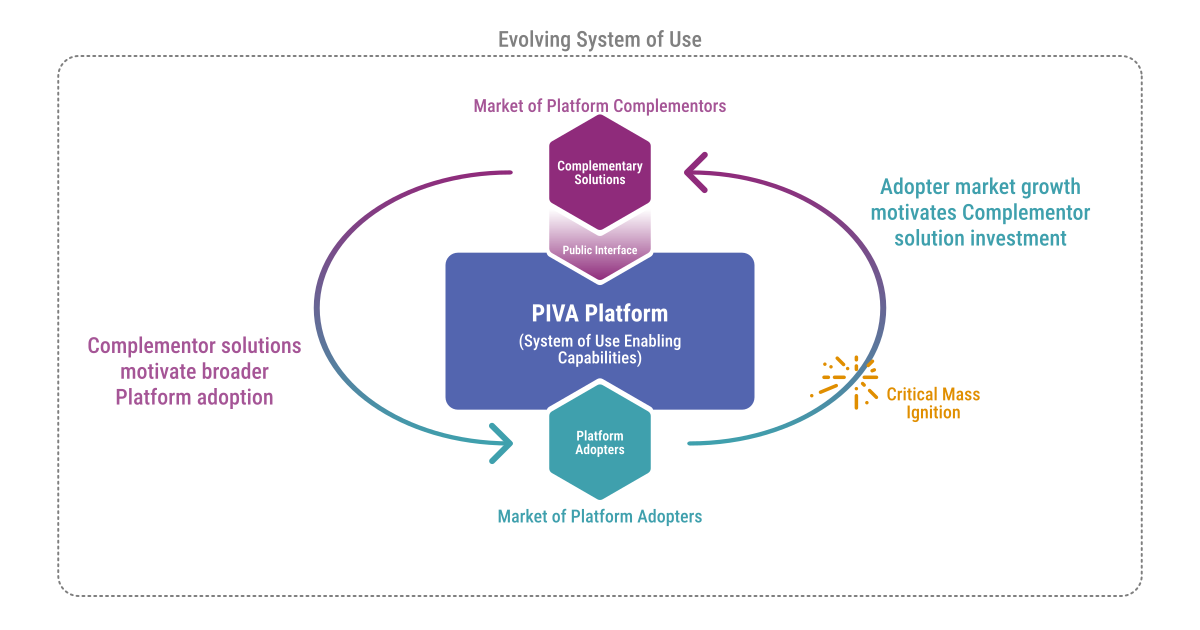
This compounding runs on the economic leverage of an ecosystem. A PIVA doesn’t build all of its own value — it organizes an ecosystem of complementors who invest their own effort and capital to make the platform more useful. That produces two advantages at once: efficiency in how value scales (much of the value is contributed, not funded by the platform owner) and durable defensive barriers (a thriving ecosystem of complements is expensive and slow for a rival to replicate). The owner captures a share of value flowing across the whole ecosystem without producing all of it.
This is why the platform-strategy literature states the case so strongly. As Marshall Van Alstyne summarized the economics, platform strategies beat product strategies — companies pursuing platform strategies are increasingly more likely to succeed financially, and companies with branded platforms benefit with disproportionate brand value growth. The compounding logic, plus the brand value that accrues to a platform others build on (Intel Inside is the canonical example), is a powerful combination.
But the research that explains the upside also names the discipline. Marco Iansiti and Roy Levien described the platform owner’s real job as a keystone role: build the platform, and share enough value with the ecosystem to keep its participants healthy and invested. The platforms that fail are rarely the ones that shared too much — they’re the ones that extracted too much, hollowing out the very ecosystem that gave them their power.
If platform economics are so compelling, why doesn’t every company build a PIVA? Three things get in the way, and the third is the one almost nobody sees coming.
They expect a PIVA’s returns from a reuse platform. Calling a reuse-and-efficiency initiative a “platform strategy” is perfectly accurate — it is one. The problem comes when a company builds that kind of platform but expects the other kind’s payoff: market share, network effects, compounding growth. The effort can be entirely sound as a reuse play and still be judged a failure, because it was measured against returns it was never designed to produce. The fix isn’t to abandon the reuse play; it’s to align intent, expectations, and execution honestly before committing. (This is the heart of an earlier BRI piece, Is Your Platform Strategy Aligned to Your Expectations? — results are always judged against expectations.)
The requirements for a true PIVA are genuinely demanding. A compounding platform has to reach critical mass — and critical mass isn’t an absolute number, it’s a threshold relative to the alternatives available to complementors and the return they can earn by participating. Getting there often means an asymmetric model that subsidizes one side of a market to ignite the other. It means architectural choices about modularity and the openness of interfaces — what to open so others can build, what to keep proprietary, the kind of design questions Clayton Christensen analyzed in his work on modular versus integrated architecture. It also means co-designing the platform’s architecture and its business model as a single, interdependent act — the two shape each other, and getting them right together demands a degree of coordination between technical and strategy leadership that many organizations simply don’t have. And it means tending the ecosystem rather than exploiting it — the lesson at the center of Epic v. Apple — Tending Your Platform Ecosystem. None of this is impossible; all of it is hard, and most of it is unfamiliar to a company that has only ever run a product business.
Most established companies aren’t built to execute a platform play. This is the invisible failure mode, and the one that does the quietest damage: Platform plays typically require Resources, Processes, and Priorities (RPPs) most established companies don’t have. Platform strategies are already high risk, high reward, but the RPP misfit is one of the most significant and invisible failure modes.
This is the dovetail between platform strategy and Company Fit — the match between a strategy and a company’s Resources, Processes, and Priorities. Company Fit / RPP misalignment is the #1 killer of innovation in mature companies — more than bad ideas or weak validation. It is especially lethal for platform plays, because a platform demands ways of operating that a product organization’s RPPs are actively tuned against: investing ahead of revenue, sharing value with outside partners, optimizing for an ecosystem instead of a product line. The misfit rarely shows up in a single decision; it shows up as the cumulative impact of many small frictions, each survivable, that together starve the platform of what it needs. And it is sneaky precisely because senior leaders don’t feel it directly — they resolve any individual issue that reaches them, so they never experience the steady accumulation quietly killing the strategy below.
A company can understand platform economics perfectly and still fail here. That’s why we treat platform potential and Company Fit as a single, paired question — assessing one without the other usually misleads.
There are really only three relationships a company can have with a platform. You can pursue a platform strategy of your own, to drive differentiation and build barriers. You can leverage someone else’s emerging platform by getting in early as a valued complementor and trying to ride the wave of growth it drives (often the safest bet). Or you can compete against a platform a rival is aiming at your product business — a different game than competing product-to-product, and one worth recognizing early (but often a losing bet).
Whichever it is, the discipline is the same: be honest about which kind of platform you’re building, align your expectations and investment to that choice, and assess — before committing — whether your company’s resources, processes, and priorities can actually carry it.
We work on platform strategy through our ‘Platform’ Strategy Development engagements, drawing on decades of practitioner experience in corporate innovation and new business development — much of it inside the technology industry, where platform plays have been uniquely powerful. Our approach works at the level of why platforms succeed or fail: the economic mechanisms (increasing-return economics, asymmetric monetization, ecosystem-investment leverage) and the operational ones (critical-mass dynamics, the platform-vs-platform boundary, ecosystem governance) — paired with a rigorous Company Fit / RPP analysis, because that pairing is where most platform strategies are quietly won or lost. We help clients define a platform-strategy hypothesis clearly and evaluate it honestly before they bet on it.
If you’re weighing a platform move — or trying to tell which kind you’re actually looking at — it’s worth a conversation. A 30-minute intro call is usually enough to know whether we can help.
A strategy built around a foundation that other products, services, and participants build on, rather than around a single product. It comes in two forms: a reuse-and-efficiency platform (value from internally shared, reusable building blocks) and a platform whose value compounds as adoption grows — what BRI calls a PIVA (Platform of Increasing Value of Adoption), driven by network effects and the leveraged investment of an ecosystem of complementors.
A product strategy competes on the merits of a product. A platform strategy competes by organizing an ecosystem and, in its most powerful form, by harnessing value that compounds as adoption grows — so advantage builds on itself rather than eroding toward equilibrium.
PIVA is BRI’s term for a Platform of Increasing Value of Adoption — a platform whose value compounds as more people adopt it, through positive feedback loops and network effects. We use the term to distinguish this compounding kind of platform from the looser, everyday use of “platform” to mean anything reusable.
Yes. A reusable-building-block (lowercase-p) platform is a legitimate, valuable strategy — its returns show up as operating efficiency rather than market share. It is not inferior to a PIVA; it is a different bet with different expectations, and the two can be complementary. The mistake is expecting compounding, market-defining economics from a reuse play.
Not in the PIVA sense. They share some traits — value rises with adoption, and complementors build on them — but because they’re open by design, the increasing value rarely accrues to any single owner. They behave more like a shared commons than a platform a single company can build a compounding strategy around.
Three common reasons: the company mislabels a reuse play as a compounding-platform play and measures it against the wrong expectations; the requirements for a true platform (critical mass, asymmetric models, ecosystem nurture) are underestimated; or — most often and most invisibly — the company’s Resources, Processes, and Priorities aren’t built to carry a platform play.
Closely. Platform plays typically require Resources, Processes, and Priorities most companies don’t have, and that misfit is one of the most significant and invisible ways platform strategies fail. BRI assesses platform potential and Company Fit together, as a single paired question.
When it genuinely intends to build value that compounds with adoption, can plausibly reach critical mass relative to complementors’ alternatives, and has — or can build — the resources, processes, and priorities a platform play requires. When those conditions don’t hold, a reuse-and-efficiency platform may be the better, and entirely legitimate, choice.
Framework references
Related thought leadership

A free, 5-minute read on where yours stands today: your strengths, your gaps, and the priorities to advance it.