‹ All Growth Forge tools

Low Fidelity Strategy Modeling Tool

The Low Fidelity Strategy Modeling Tool is the Growth Forge® Software starting point for quickly defining a simple but complete strategy hypothesis, evaluating its desirability, feasibility, and viability, and planning the first experiments to test it, before committing significant resources.

who it's for

New-product or business project leaders and startup founders at the very earliest stage, exploring and pressure-testing a concept before investing in detailed modeling.

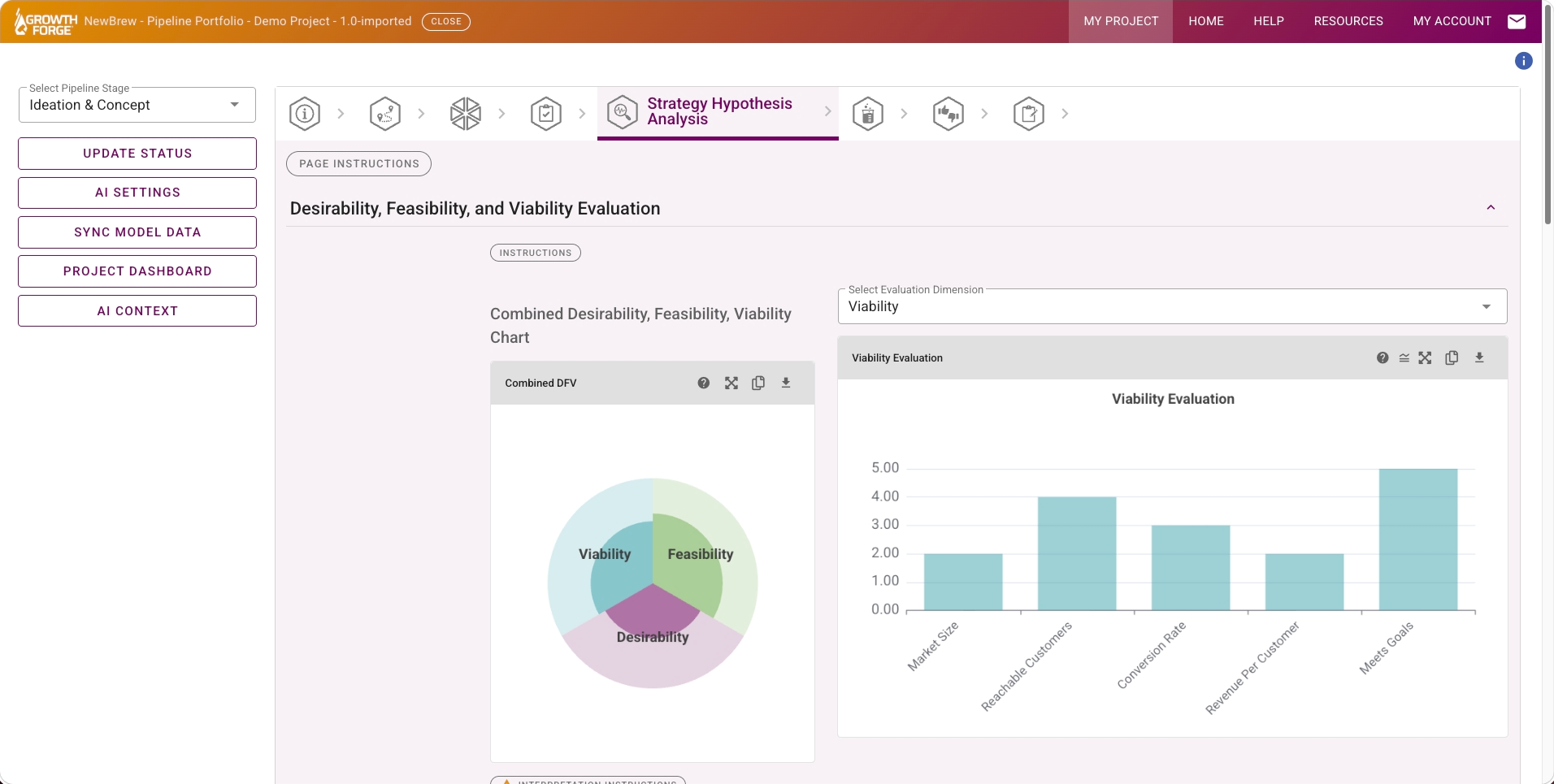
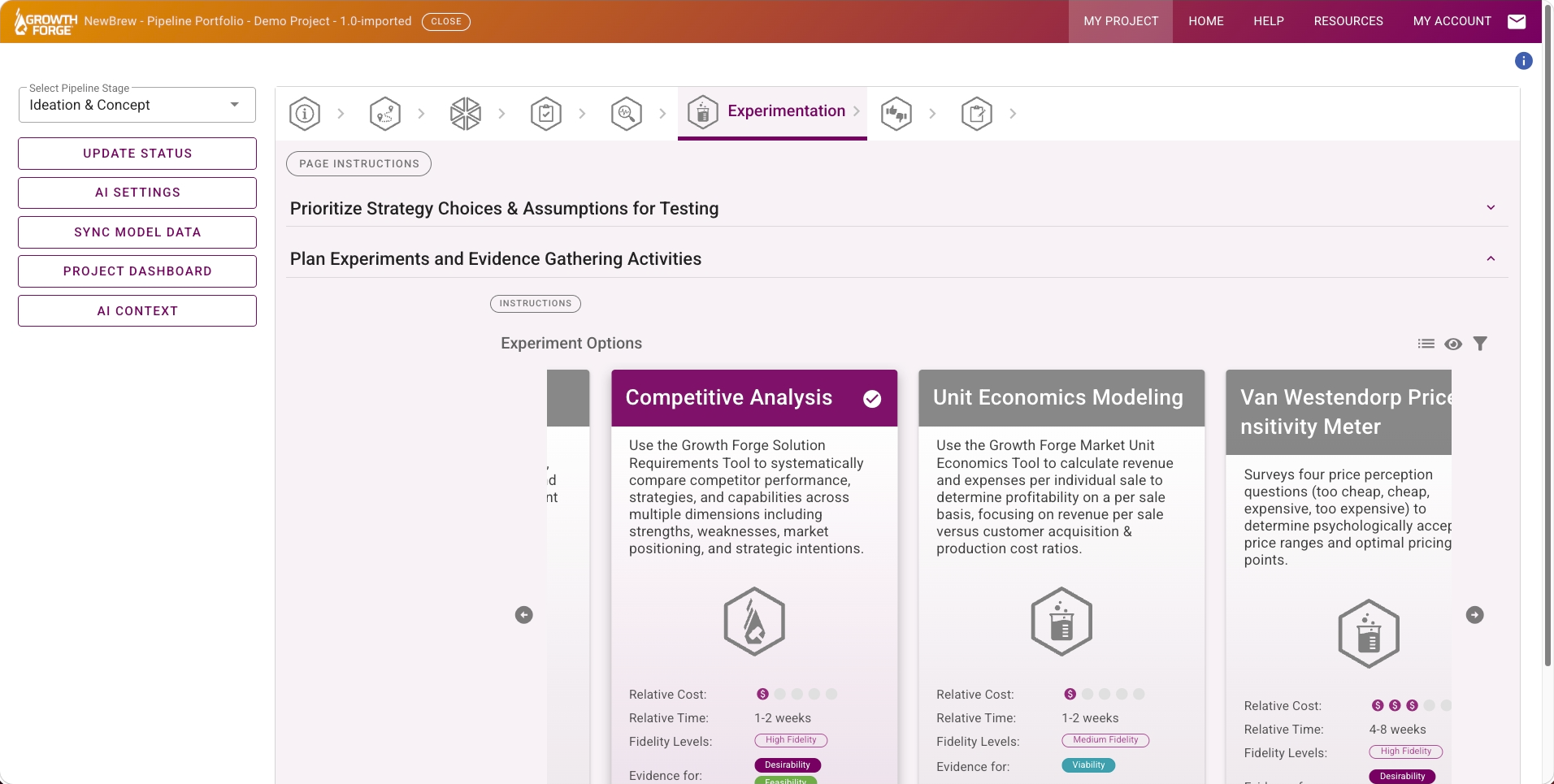
Growth Forge Low-Fidelity Strategy Modeling: Intro step showing the five-step low-fidelity flow
Why it matters

Benefits

  • Form a complete strategy hypothesis fast, without premature detail.
  • Evaluate an idea across all three dimensions of desirability, feasibility, and viability, early, before getting too attached to a specific strategy hypothesis.
  • Explore several strategic options and pivot on learning instead of over-committing to one.
  • Move from idea to first experiments quickly, balancing speed with rigor.
What it does

Features

  • A guided five-step process from strategic goal to evidence-based next steps.
  • Captures the essential strategy elements at low fidelity, ready for iterative refinement.
  • Built-in desirability / feasibility / viability evaluation.
  • Order of Magnitude financial assessment and what-if modeling.
  • Plan initial experiments to test the riskiest parts of the hypothesis.
  • Auto-generated printable full strategy hypothesis, evaluation, and action plan report.

How it works

  1. Set the strategic goal for the concept.
  2. Capture the essential elements of a simple but complete strategy hypothesis.
  3. Evaluate it across desirability, feasibility, and viability.
  4. Plan the first experiments to test the riskiest assumptions.
  5. Decide whether to advance, refine, or drop the concept, feeding evidence to your Strategy Evaluation.

FAQs

What is the Low Fidelity Strategy Modeling Tool in Growth Forge?

It's the fast, foundational tool for articulating a simple but complete strategy hypothesis, evaluating its desirability, feasibility, and viability, and planning first experiments, before you invest in detailed modeling.

How do I quickly test a new business or product idea?

Set the goal, capture a simple-but-complete hypothesis, evaluate it on desirability, feasibility, and viability, and plan first experiments. Working at low fidelity lets you explore several options and pivot on evidence rather than over-committing early.

Why start at low fidelity?

Early on, speed and flexibility matter more than precision. Low fidelity lets you test fundamental assumptions and compare options cheaply, then deepen the model only once a direction earns it.

How does it relate to the detailed tools?

It's the on-ramp, once a hypothesis looks worth pursuing, you develop it further in the higher-fidelity tools (Value Propositions, Market Segmentation, Strategy Builder, and the rest).

What does it connect to?

It feeds the higher-fidelity strategy-modeling tools and contributes early evidence to your Strategy Evaluation.
Package Availability
Enterprise PortfolioSmall Business PortfolioAdvanced Business Modeling
Basic Business Modeling

Ready to transform your new product and business innovation process?

Join companies worldwide using Growth Forge to build better strategies and drive new business growth results.